
Small Language Models: The Low Cost AI Option Nepal Can Actually Afford.
Every discussion about AI in Nepal starts with the same equation. Big models need big GPU servers. Big GPU servers need big money, and often a cloud account billed in foreign currency. That equation pushes most companies straight to the conclusion that AI is not something they can run themselves
Here is the part those conversations leave out. You do not always need a big model. A whole family of small language models now runs on a laptop, a single office PC, or a modest server you already own. They cost almost nothing to operate, they keep your data inside the building, and for a surprising number of daily business tasks they are good enough.
This article is about when small language models make real sense, where they fall short, and how to measure whether one fits the work your team does. Let me explain the split in plain terms.
What small language models actually are
A small language model is a language model trained to run on limited hardware. It has fewer parameters than the models you rent by the API call. Where a giant frontier model might need a rack of GPUs, a small model can sit in a few gigabytes of memory and answer questions on a single machine.
Size is not quality, and it is not a weakness either. A smaller model is simply a model tuned for a narrower job. A model built to summarize support tickets can beat a huge general model at that one task, while using a fraction of the electricity.
Here is what matters. When a task is narrow and repeated, a small language model often wins on every measure that a business cares about. It is cheaper, it is faster, and it is easier to control because it lives on your own hardware.
Why small language models cost so much less
The price gap is the whole reason this topic keeps coming up. When you rent a big model through an API, you pay per token, per month, and usually in a foreign currency. Every long conversation, every repeated job, every retry adds a new line to the invoice.
By contrast, a small model that runs in your office costs power and a little storage. Once it is installed, the marginal cost of another request drops to nearly zero. There is no per token meter, no surprise bill at the end of the month, and no need to move money out of the rupees that your business already earns.
Put that next to a task your team does all day. A support chatbot handling twenty thousand similar questions a month gets cheap in a way that a per use cloud model never does. That single difference can decide whether the tool stays on or gets turned off.
Where small language models fall short
Let me be honest before recommending anything. There are jobs a small model cannot handle well. Complex multi step reasoning, long creative writing, and any task that depends on a deep base of knowledge still lean on the big models. Push a small model past its training and it will hand you a confident but inaccurate answer.
The trick is matching the size to the task. Drafting a contract clause with many legal edge cases is a big model job. Pulling a name, a date, and an amount out of a scanned form is a small model job. Get that match right and you keep the quality while removing most of the cost.
That call is the real difference between on device AI and cloud AI. It is also why you can run both at once instead of treating them as a permanent either or choice.
How small language models solve the Nepal data problem
Nepali companies hold more data than they can safely send abroad. Bank records, patient files, and government paperwork carry their rules about where they can be stored and who can touch them. Even when the rule is stretched, customers notice when their details leave the country.
A small language model that runs on a server in your own office answers this problem directly. The data never leaves the building. There is no third party to audit, no foreign server to name, and no long terms of service clause that quietly moves files somewhere else.
For a hospital holding patient histories, or a finance firm holding client ledgers, that result alone is enough to look at a small model before any cloud subscription is signed.
What small language models mean for the cost equation
The economics have shifted, and many owners have not felt the change yet. Older thinking said every digital project grows by buying more server power abroad. That is still the default path, but it is no longer the only path.
Real money can be saved by running small language models on equipment the company already owns. The hardware is often sitting in the corner doing light work. The models are free to download. The skill to set them up is a day of training instead of a slow procurement process.
Here is the bottom line. This is not an argument against cloud AI. It is an argument for checking both sides before you choose. Sometimes the big model is the right tool. Sometimes the small one is, and the savings arrive immediately.
A fair list of small language model wins and where to start
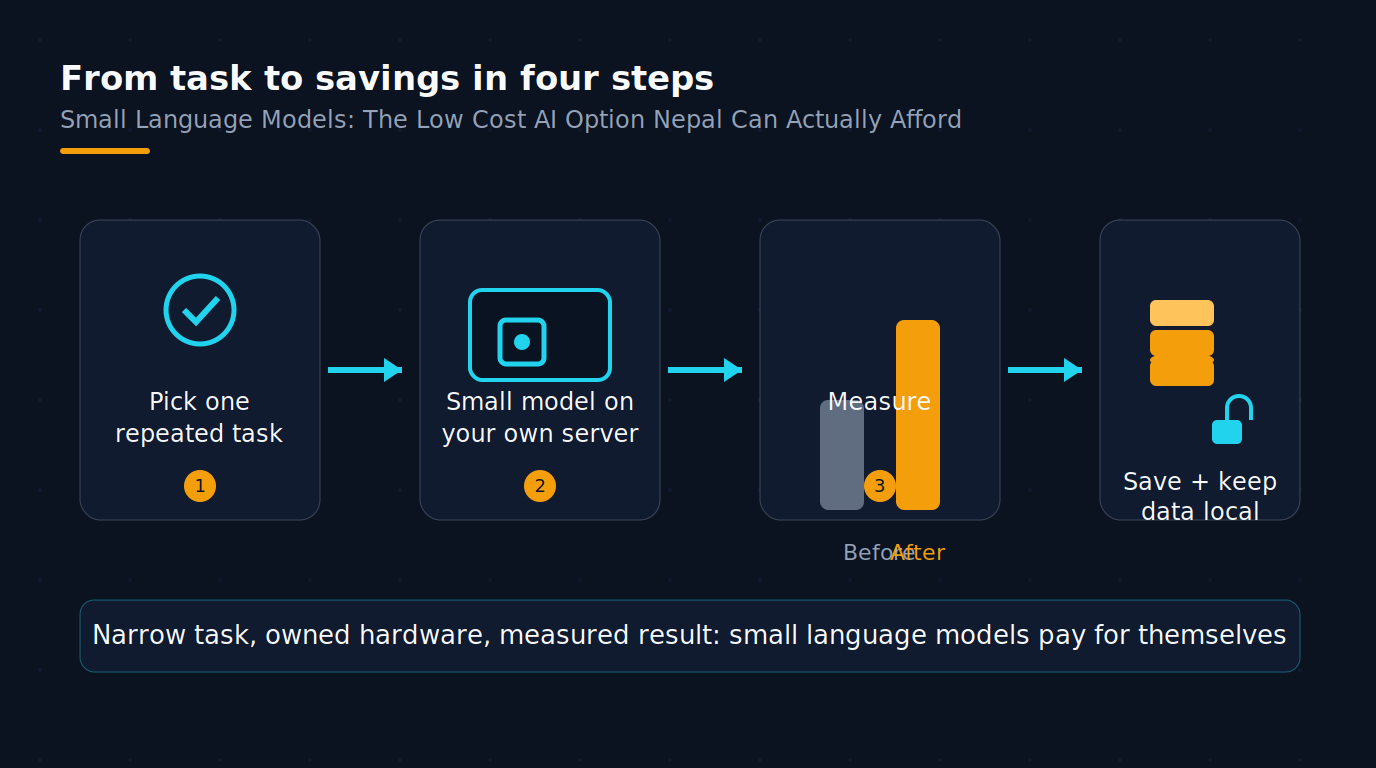
Suppose you want to capture what small language models offer. Where does a real team begin? Pick one repeated, boring, rule based task close to the data. A form completion, a product tagger, a routine reply that your staff retype ten times a day.
Download an open model that fits the memory you already have. Test it on the same ten real cases your team handles by hand. Measure the outcome against what happened before. Does it match quality within the time budget? Does it run quietly on the hardware you own?
If the answer is yes for several steps, you have a tool that pays for itself daily, with no per token attachment and no foreign invoice. This does not demand a data science team. It requires a clear task and the discipline to test it against a baseline.
That discipline is the same requirement for any AI project worth starting. It will save you from being priced out of a genuinely valuable tool year after year.
One more point worth making. The best time to test a small model is not when you already have a heavy cloud contract. It is when you are starting fresh, or when a renewal lands on the desk. Those moments force a real comparison, and they are exactly when the cost difference shows up most clearly. A team that builds the habit of checking the small option before every new AI spend stops paying for more machine than the task needs. Even a modest pilot that runs for two weeks gives you numbers you can carry into any budget meeting, and numbers beat opinions every time.
FAQ
1. What are small language models best at in a business? They shine at narrow repeated tasks, pulling fixed fields out of documents, sorting incoming queries, and answering the routine messages. They are the steady workhorse that earns no special attention when they work right.
2. Do I need expensive hardware to run one? Most of the time, no. Many small models run on an ordinary office laptop or server with a few gigabytes of memory. A small GPU makes content go faster, but it is rarely required to get started.
3. How do small language models compare to big cloud APIs? Big APIs win on raw intelligence and depth. Small local models win on price per request, privacy, and speed on everyday duty. They are compliments, not replacements, and most teams use both.
4. Can I run one without sending data abroad? Yes, and that is the main reason to look at them. When the model runs on your own server, the data stays in your building, with no risk of a foreign copy and no third party contract to review.
5. What should I not trust to a small language model? Avoid long creative writing, deep multi step analysis, or answers that depend on a very large body of recent information. Keep those with the big model, and let the small model handle the repeated narrow work.
Take the Next Step
Start with one narrow task your team repeats every week. Set it up on hardware you already own and measure the result against the old way of working. When you want help choosing a model that fits your server and your budget, the team at Synergy Digital knows both the small and the large side of this picture. Visit https://www.synergy.com.np, tell them the task you want to sharpen, and get a measured answer instead of a guess.