
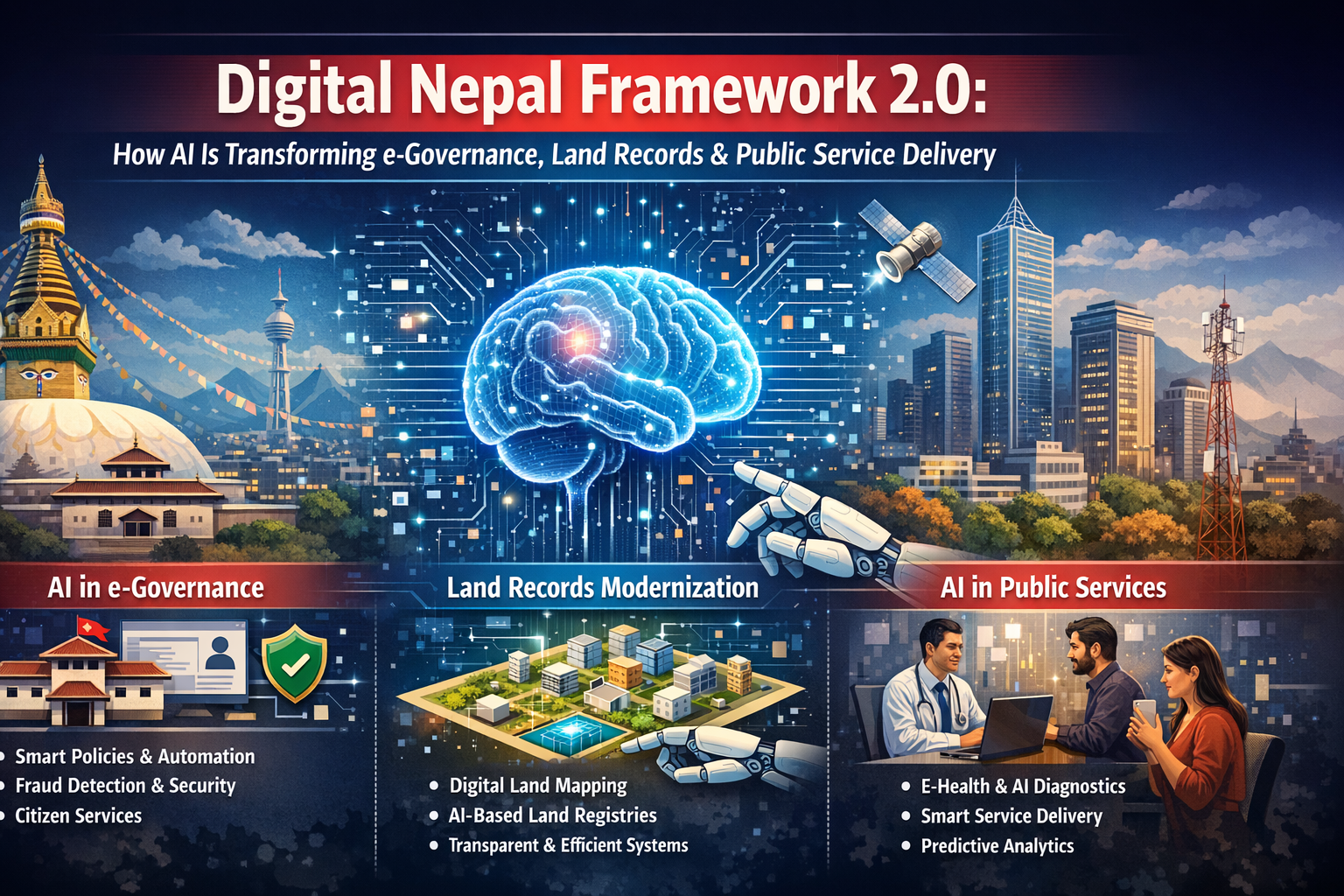
Nepal has spent years building digital roads. We have online portals, mobile banking, and government portals that actually work. The next step is not just putting forms on a screen. It is about making those systems think, adapt, and serve people faster. Artificial intelligence is the engine behind that shift. It does not replace civil servants. It removes the friction that slows them down.
The government’s updated strategy, Digital Nepal Framework 2.0, puts machine learning and pattern recognition at the center of public service delivery. The plan moves past digitization and toward automation that understands context. Here is how that shift changes everyday governance, land management, and citizen services.
Digital Nepal Framework 2.0 and the Push for Smarter E-Governance
E-governance used to mean scanning paper into a database. That created searchable archives but left the same bottlenecks intact. Officials still spent hours matching names, verifying addresses, and chasing missing signatures. AI changes that by reading documents, spotting inconsistencies, and routing tasks automatically.
Let me explain how this works in practice. A citizen submits a business registration form. The system checks the name against existing records, flags duplicate entries, verifies the tax identification number, and sends the file to the right department. A human reviews only the flagged items. The rest move forward without waiting in line.
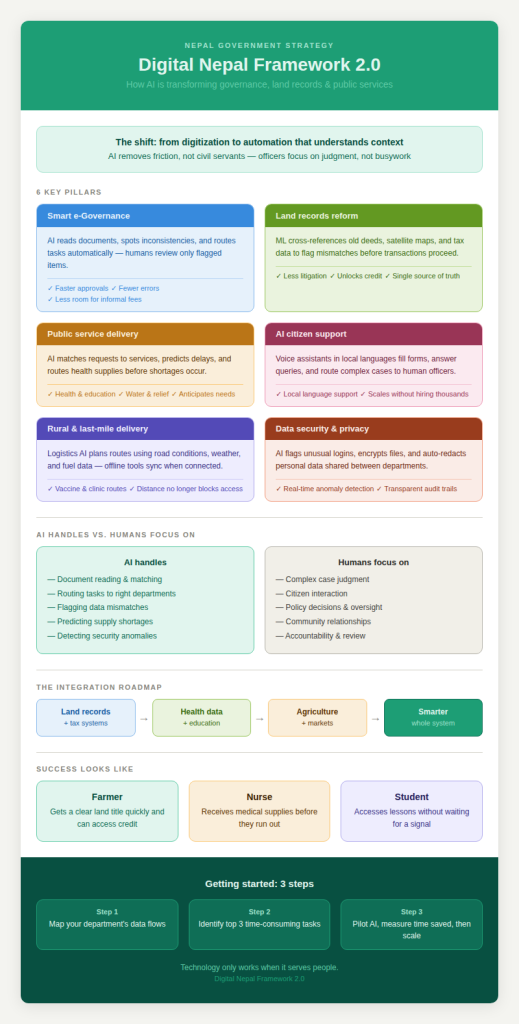
Here is what matters. Automation does not mean removing oversight. It means removing busywork. When routine checks happen in seconds, officers spend their time on cases that actually need judgment. The result is faster approvals, fewer errors, and less room for informal fees. Digital Nepal Framework 2.0 treats data as a living resource. It connects ministries so information flows instead of getting stuck in silos.
Digital Nepal Framework 2.0 in Land Records: Ending the Paper Trail
Land disputes drain time, money, and trust. Many cases stall because old records contradict each other. Handwritten registries, missing maps, and overlapping claims create years of legal backlog. AI brings consistency to a system that has relied on fragile paper trails for decades.
Machine learning models can cross-reference old deeds, satellite imagery, survey markers, and tax payments. They flag mismatches before a transaction moves forward. When a buyer checks a property, the system pulls the full history, highlights gaps, and suggests which documents need verification. Surveyors use drone footage and ground sensors to update boundaries. The database stays current instead of waiting for a physical audit.
The reality is straightforward. Clear records reduce litigation. They also unlock credit. Farmers and small business owners struggle to get loans when ownership is unclear. Digital land records with AI verification give lenders confidence. They give citizens certainty. Digital Nepal Framework 2.0 treats land data like infrastructure. It builds a single source of truth that everyone can trust.
Digital Nepal Framework 2.0 for Public Service Delivery
Citizens do not care about ministry names. They care about whether a certificate arrives, whether a subsidy reaches their account, and whether a complaint gets a real response. AI improves delivery by matching requests to the right service, predicting delays, and keeping people informed.
Consider a rural health post. Staff upload patient records and request medical supplies. The system analyzes usage patterns, checks stock levels across districts, and routes shipments to where they are needed most. It also flags clinics running low on essential medicines before shortages happen. The same logic applies to education, water distribution, and disaster relief.
Bottom line. Service delivery improves when systems anticipate needs instead of reacting to crises. AI does not replace human care. It removes the administrative drag that keeps services from reaching the people who need them. Digital Nepal Framework 2.0 builds that anticipation into the backbone of public operations.
Digital Nepal Framework 2.0 and AI-Driven Citizen Support
Language and accessibility still separate citizens from services. Many government portals assume English or Nepali fluency. They assume stable internet. They assume users know how to navigate complex forms. AI closes those gaps by adapting to how people actually communicate.
Voice-enabled assistants can take requests in local languages. They translate them into structured data, fill out forms, and return clear next steps. Chatbots handle routine questions about deadlines, required documents, and office hours. When a request gets complicated, the system routes it to a human officer with full context already attached.
This is not about replacing call centers. It is about scaling basic support without hiring thousands of new staff. Digital Nepal Framework 2.0 treats citizen interaction as a continuous loop. Every question improves the system. Every resolved case trains the model. The result is faster answers, fewer repeat visits, and services that actually speak the language of the people.
Digital Nepal Framework 2.0 in Rural Access and Last-Mile Delivery
Geography has always been Nepal’s biggest administrative barrier. Mountain roads, seasonal floods, and remote settlements make physical service delivery expensive and slow. AI changes the math by optimizing routes, predicting disruptions, and pushing services closer to communities.
Logistics models analyze road conditions, weather forecasts, and fuel costs to plan delivery schedules. Health workers receive optimized routes for vaccine drops and mobile clinic visits. Teachers get digital lesson plans that work offline and sync when connectivity returns. Local governments use predictive analytics to prioritize road repairs and drainage projects before monsoon damage spreads.
The shift is practical. It does not require building new highways. It requires using existing data to move resources where they matter most. Digital Nepal Framework 2.0 treats connectivity as a network, not a luxury. It ensures that distance does not dictate access.
Digital Nepal Framework 2.0 and Data Security
Automation only works when trust exists. Citizens will not use digital services if they fear leaks, fraud, or unauthorized access. AI strengthens security by detecting anomalies, encrypting sensitive files, and monitoring system behavior in real time.
Machine learning models flag unusual login patterns, track data access logs, and alert administrators before breaches occur. They also help enforce privacy rules by automatically redacting personal information when data moves between departments. Audit trails become transparent instead of hidden in paper folders.
Security is not an afterthought. It is the foundation. Digital Nepal Framework 2.0 builds privacy into the architecture. It treats citizen data as a protected asset, not a free resource. When people know their information is safe, they participate. When they participate, the system improves.
Digital Nepal Framework 2.0: What Comes Next
The framework is a roadmap, not a finished product. Implementation will depend on training, infrastructure, and consistent funding. Some ministries will move faster than others. Some regions will see results sooner. That is normal. The goal is steady progress, not overnight perfection.
The next phase focuses on integration. Connecting land records with tax systems. Linking health data with education programs. Feeding agricultural outputs into market platforms. Each connection multiplies the value of the data. Each integration reduces duplication. The system becomes smarter because it shares information responsibly.
Here is what matters most. Technology only works when it serves people. Digital Nepal Framework 2.0 succeeds when a farmer gets a clear land title, a nurse receives supplies on time, and a student accesses lessons without waiting for a signal. The rest is details.
Take the Next Step
Start mapping your department’s data flows. Identify the three most time-consuming processes. Test a small AI pilot. Measure the time saved. Scale what works. The framework is ready. The next move is yours.
FAQ
What is Digital Nepal Framework 2.0?
It is the updated national strategy that uses artificial intelligence, data sharing, and automation to modernize e-governance, land management, and public service delivery across Nepal.
Will AI replace government workers?
No. AI handles routine checks, data matching, and routing. Human officers focus on complex cases, oversight, and citizen interaction. The goal is to remove busywork, not jobs.
How does AI improve land records?
It cross-references old deeds, satellite maps, and tax data to spot mismatches. It creates a single verified record that reduces disputes and makes property transactions faster.
Can rural areas benefit from these changes?
Yes. AI optimizes delivery routes, predicts disruptions, and enables offline digital tools. It ensures geography does not block access to services.
Is citizen data safe under this framework?
The system uses encryption, access controls, and real-time monitoring to protect information. Privacy rules are built into the design, not added later.