
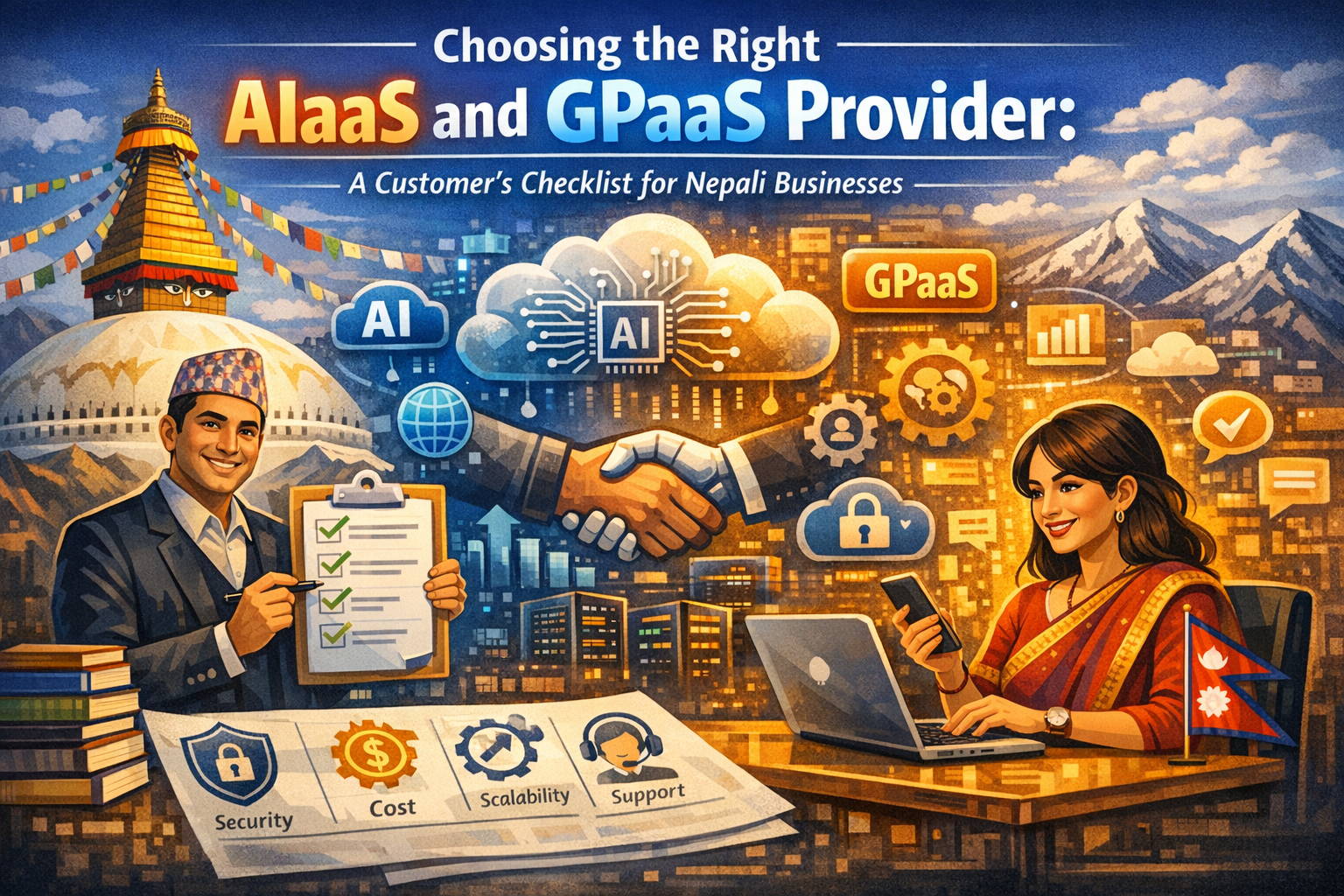
You do not need a datacenter full of graphics cards to run machine learning models anymore. You just need the right cloud partner. Nepali businesses are moving from buying hardware to renting compute power. The shift makes sense. Hardware loses value the moment you unbox it. Cloud compute charges you only for what you run. The problem is not the technology. The problem is picking the wrong vendor.
Many teams sign contracts based on marketing slides. They learn the hard way when bills spike, support goes silent, or models run slow because the server sits in a different continent. Here is what matters. You need a clear set of questions before you hand over your data or your budget. Below is a practical checklist to help you evaluate any AIaaS and GPaaS Provider in Nepal.
How an AIaaS and GPaaS Provider in Nepal Handles Your Data
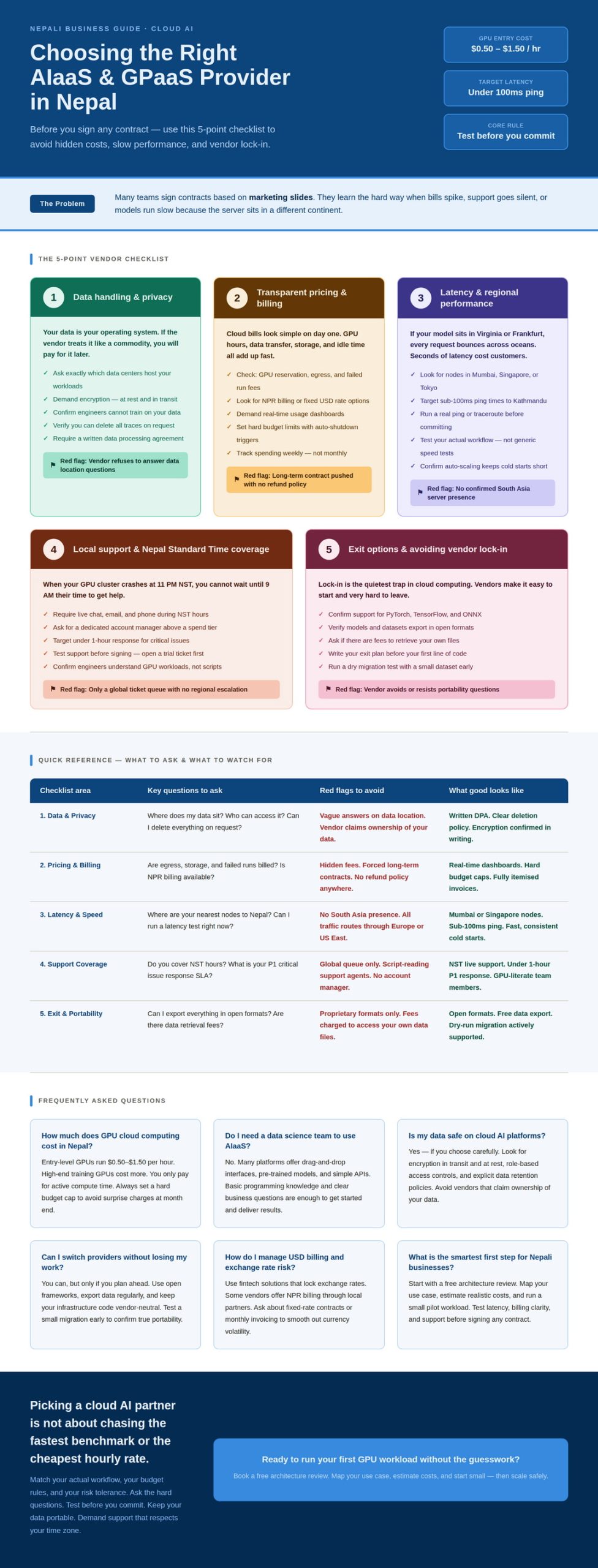
Your data is your operating system. If the cloud vendor treats it like a commodity, you will pay for it later. Look for clear data handling policies. Ask where your training data sits. Ask who can access it. Ask how long they keep logs after your session ends.
Let me explain why this matters in Nepal. Local businesses often store customer records, financial data, or internal research on these platforms. If a provider stores your files in a region with weak privacy laws, you inherit their legal risk. A trustworthy vendor will tell you exactly which data centers host your workloads. They will also explain encryption standards for data at rest and in transit.
Here is what matters. Demand a written data processing agreement. Check if they allow you to delete all traces of your data on request. Verify that their engineers do not use your data to train their own models. If they refuse to answer these questions, walk away. Bottom line. Your data stays yours. The vendor only rents you the brain to process it.
Why an AIaaS and GPaaS Provider in Nepal Must Offer Transparent Pricing
Cloud bills can look simple on day one. They rarely stay that way. GPU hours cost money. Data transfer costs money. Storage costs money. Idle time costs money. If a vendor hides these fees behind vague terms, you will face shock invoices.
A reliable AIaaS and GPaaS Provider in Nepal will show you the full cost breakdown before you click install. Look for clear pricing tables. Check if they charge for GPU reservation, spot instances, or network egress. Ask how they bill for storage that sits unused. Ask if they charge for failed training runs.
Let me explain how this plays out locally. Many Nepali teams pay in USD. Exchange rate swings can double your monthly spend overnight. A good provider will lock your rate for a set period or offer NPR billing through a trusted local partner. They will also give you usage dashboards that update in real time. You should see exactly how many credits you burned and why.
Here is what matters. Set a hard budget limit with automatic shutdown triggers. Track your spend weekly, not monthly. If a vendor pushes you toward a long-term contract without a clear refund policy, pause. Transparent pricing is not a luxury. It is the baseline for any serious cloud partnership.
What an AIaaS and GPaaS Provider in Nepal Should Deliver for Latency
Latency is the silent budget killer. It slows down development, frustrates developers, and breaks real-time AI applications. If your model lives in Virginia or Frankfurt, your requests will bounce across oceans. That adds seconds to every inference. Seconds add up to lost customers.
A competent AIaaS and GPaaS Provider in Nepal will place edge nodes or regional data centers close to South Asia. Look for providers with infrastructure in Mumbai, Singapore, or Tokyo. These locations typically offer sub-100 millisecond ping times to Kathmandu. Ask for a latency test before you commit. Run a simple ping or traceroute to their main compute endpoints.
Let me explain why this matters for local teams. Nepali developers often build chatbots, recommendation engines, or computer vision tools that need fast responses. If the cloud provider forces you to route traffic through Europe, your app will feel sluggish. You will blame your code when the problem is geography.
Here is what matters. Test your actual workflow, not a generic speed test. Measure how long it takes to send a prompt and get a response. Check if the provider offers auto-scaling that keeps cold starts short. If latency drags, your AI will not scale. Bottom line. Pick a vendor whose servers sit close enough to keep your apps fast.
How an AIaaS and GPaaS Provider in Nepal Supports Local Teams
Technology fails. When it does, you need help that understands your time zone and your constraints. A vendor that only answers tickets through a global queue will leave you stuck for days. Look for support that matches your working hours.
A strong AIaaS and GPaaS Provider in Nepal will offer live chat, email, and phone support during Nepal Standard Time business hours. They should also provide detailed documentation, video walkthroughs, and community forums. Ask if they assign a dedicated account manager for teams above a certain spend tier. Check their average response time for critical issues.
Let me explain the reality on the ground. Nepali IT teams often work late to sync with international clients. If your GPU cluster crashes at 11 PM, you cannot wait until 9 AM their time to get help. A responsive support team will acknowledge your ticket within an hour and give you a clear path to resolution. They will also help you troubleshoot driver mismatches, container errors, or billing disputes without making you repeat yourself.
Here is what matters. Test their support before you sign. Open a trial ticket. See how fast they reply. Check if their engineers actually understand GPU workloads or if they just read from a script. Good support saves projects. Bad support burns budgets.
Why an AIaaS and GPaaS Provider in Nepal Needs Clear Exit Options
Lock-in is the quietest trap in cloud computing. Vendors make it easy to start. They make it hard to leave. You will find your data stuck in proprietary formats. Your pipelines will depend on their custom tools. Moving to another provider will feel like rebuilding from scratch.
A responsible AIaaS and GPaaS Provider in Nepal will design their platform for portability. They should support standard frameworks like PyTorch, TensorFlow, and ONNX. They should allow you to export models, datasets, and configuration files in open formats. Ask about their data export process. Check if they charge fees to retrieve your files.
Let me explain why this matters for long-term planning. Your AI needs will change. You might outgrow a small cluster. You might switch to a different cloud for better pricing. You might bring training in-house. If your vendor makes it difficult to leave, you lose leverage. You will accept bad pricing or poor performance because the switching cost feels too high.
Here is what matters. Write your exit plan before you write your first line of code. Keep your infrastructure as code. Store your data in neutral formats. Test a dry run migration with a small dataset. If a vendor resists your questions about portability, treat it as a red flag. Flexibility is not optional. It is your insurance policy.
Bottom Line
Picking a cloud AI partner is not about chasing the fastest benchmark or the cheapest hourly rate. It is about matching your actual workflow, your budget rules, and your risk tolerance. Use this checklist as a filter. Ask the hard questions. Test before you commit. Keep your data portable. Track your spend. Demand support that respects your time zone. The right AIaaS and GPaaS Provider in Nepal will make your work easier, not harder.
Ready to run your first GPU workload without the guesswork? Book a free architecture review with our team. We will map your use case, estimate your costs, and show you exactly how to start small and scale safely.
FAQ
1. How much does GPU cloud computing cost in Nepal?
Hourly rates depend on the GPU model. Entry-level cards usually run between $0.50 and $1.50 per hour. High-end training GPUs cost more. You only pay for active compute time. Storage and data transfer add small fees. Always set a budget cap to avoid surprise charges.
2. Do I need a data science team to use AIaaS services?
No. Many platforms offer drag-and-drop interfaces, pre-trained models, and simple API integrations. You can build chatbots, image classifiers, or text analyzers without writing deep learning code. Your team only needs basic programming knowledge and clear business questions.
3. Is my data safe when using cloud AI services in Nepal?
Yes, if you choose a vendor with strong security practices. Look for encryption in transit and at rest, role-based access controls, and clear data retention policies. Avoid providers that claim ownership of your data or use it for their own model training without explicit consent.
4. Can I switch cloud providers later without losing my work?
You can, but you must plan for it. Use open frameworks, export your data regularly, and keep your infrastructure code independent of vendor-specific tools. Test a small migration early. The easier it is to leave, the better your negotiating position will be.
5. How do I handle USD billing and exchange rate changes?
Many Nepali businesses use corporate credit cards or fintech solutions that lock exchange rates. Some cloud vendors partner with local payment processors to offer NPR billing. Ask your provider about fixed-rate contracts or monthly invoicing to smooth out currency swings.


