

A few years ago, the only question that mattered when choosing GPU compute was cost. How much per hour? How fast is the hardware? How quickly can I spin it up?
That question still matters. But in 2026, a second question has become just as important — maybe more so for certain industries and certain regions.
Where does my compute actually run?
This is not an abstract concern. Governments across Europe, Asia, and the Middle East are passing laws that restrict where sensitive data can be processed. Industries like healthcare, finance, and defense are discovering that their AI workloads cannot legally run on US-based infrastructure. And a separate wave of businesses — in manufacturing, logistics, agriculture, and telecoms — are finding that cloud-based GPU compute is simply too slow for what they need, because the data has to travel too far before the AI can act on it.
These two forces — regulatory sovereignty and physical latency — are reshaping GPU as a Service from the ground up. Here is what every business needs to understand.
Table of Contents
1. What Edge AI Actually Means — and Why It Is Not the Same as Edge Computing
The term gets used loosely, so let us be precise.
Edge computing means running compute closer to where data is generated — in a factory, a retail store, a hospital ward, a vehicle — rather than sending everything to a centralized cloud data center. That concept has been around for over a decade.
Edge AI is specifically about running AI inference at that location. Not just storing or routing data locally, but actually executing the model — making the decision, generating the output, triggering the action — right where the data originates.
The difference matters because AI inference has very different requirements from general compute. It needs specific hardware — GPUs, TPUs, or purpose-built AI accelerators. It needs optimized models that can run efficiently on constrained hardware. And it needs to be reliable, because in many edge AI deployments, a network outage cannot be allowed to stop operations.
GPU as a Service is evolving to meet this. Cloud providers and specialist vendors are extending their infrastructure to edge nodes — smaller GPU clusters deployed in regional data centers, on-premises facilities, and even embedded in industrial equipment.
Why it matters for your business: If your AI system needs to respond in milliseconds, or if it processes data that cannot leave a specific physical location, edge GPU deployment is not a nice-to-have. It is a requirement.
2. The Latency Problem That Cloud-Only GPU Cannot Solve
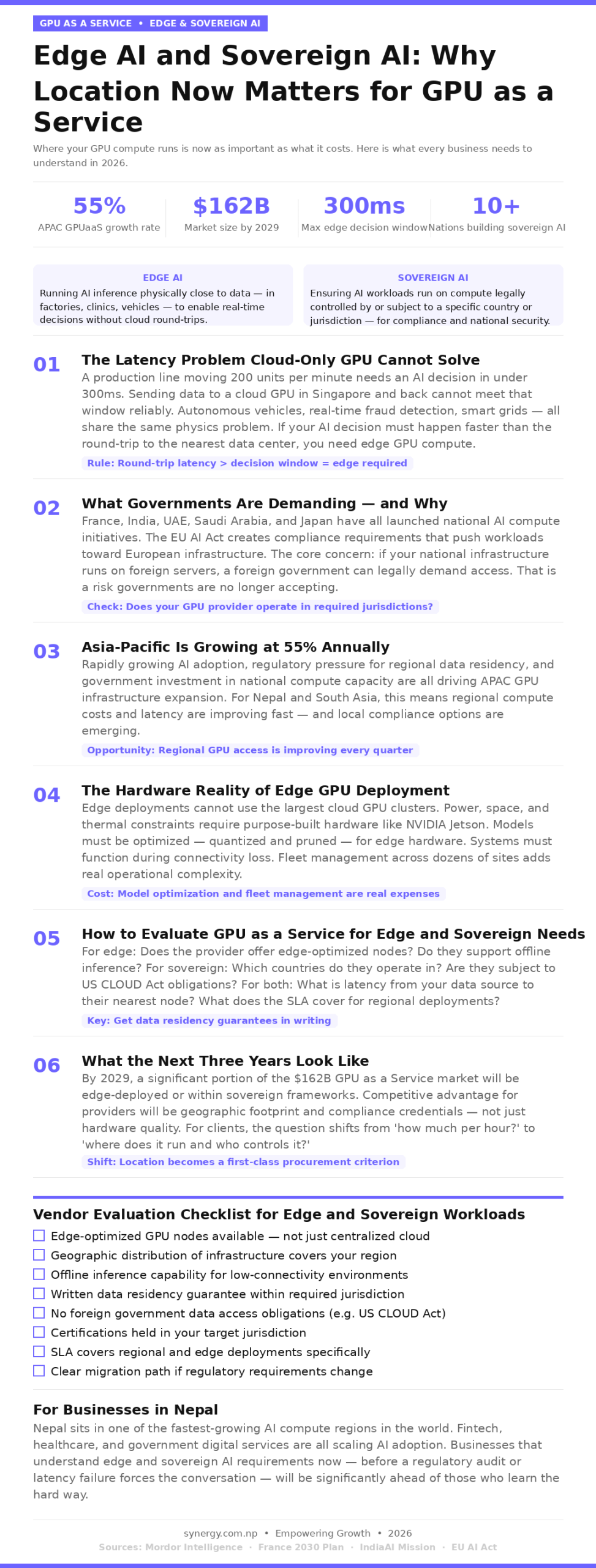
Here is a concrete scenario. A manufacturing plant uses computer vision to inspect products on a production line moving at 200 units per minute. Each unit needs to be analyzed and either approved or flagged within 300 milliseconds — because that is how long before it reaches the next station.
Sending that image data to a cloud GPU data center in Singapore or Mumbai, running inference, and getting a result back in 300 milliseconds is not reliably achievable. Network latency alone — even on a good connection — eats most of that window. Add processing queue time and the numbers do not work.
The only solution is inference at the edge. A GPU running locally, processing the image before it ever touches the internet.
This pattern repeats across industries. Autonomous vehicles making split-second steering decisions. Smart grid systems responding to power fluctuations in real time. Medical imaging analysis in rural clinics with unreliable connectivity. Fraud detection systems that need to approve or decline a transaction before the customer’s patience runs out.
In every case, the physics of data travel create a hard ceiling on what cloud-only GPU as a Service can achieve. Edge deployment breaks that ceiling.
The rule of thumb: If your AI decision needs to happen faster than the round-trip time to the nearest data center, you need edge GPU compute.
3. Sovereign AI — What It Means and Why Governments Are Demanding It
Sovereign AI is a different kind of location problem. It is not about speed. It is about control.
The concept is straightforward: a country, a region, or an organization asserts that AI workloads involving its citizens’ data, its national infrastructure, or its sensitive government systems must run on compute that it controls — or at minimum, compute that is legally subject to its jurisdiction.
This is not theoretical. France has invested heavily in building national AI infrastructure under its France 2030 plan. India’s IndiaAI Mission is building sovereign GPU capacity to reduce dependence on foreign cloud providers. The UAE, Saudi Arabia, and Japan have all launched national AI compute initiatives with explicit sovereignty goals. The EU AI Act creates compliance requirements that effectively push certain workloads toward European infrastructure.
The driving concern is straightforward. If your country’s healthcare system, power grid, or financial infrastructure is running on AI models hosted on foreign servers, a foreign government can — under its own laws — demand access to that data or those systems. That is a national security risk that governments are no longer willing to accept.
For businesses, sovereign AI requirements translate into practical purchasing constraints. If you work with government entities, healthcare systems, or regulated financial institutions in countries with data sovereignty rules, you may be required to use GPU as a Service providers that operate infrastructure within specific jurisdictions.
What to check: Does your current GPU provider operate data centers in the jurisdictions your contracts require? If not, you may already have a compliance problem.
4. Asia-Pacific Is the Fastest-Growing Region in GPU as a Service — Here Is Why
The Asia-Pacific region is expanding its GPU as a Service capacity at nearly 55% annually — faster than any other region in the world. That growth is not random.
Several forces are driving it simultaneously. Rapidly growing AI adoption across India, Southeast Asia, South Korea, Japan, and Australia is creating enormous demand for local compute. Regulatory pressure in multiple countries is pushing workloads toward regional infrastructure. And a growing awareness of the strategic risks of dependence on US-based hyperscalers is motivating both governments and enterprises to build and use local alternatives.
For Nepal and neighboring South Asian countries, this regional build-out is directly relevant. As regional GPU infrastructure expands, the cost and latency of accessing high-quality compute from within the region decreases. Workloads that previously had no viable local option are gaining one.
Nepal’s digital economy is growing. Fintech, e-commerce, agriculture technology, and health technology businesses are all beginning to deploy AI. As they scale, the question of where their compute runs — and whether it meets evolving regional regulatory requirements — will become increasingly consequential.
The opportunity: Businesses in Nepal that understand sovereign AI requirements now are better positioned to serve government clients, healthcare institutions, and regulated industries as those sectors increase AI adoption over the next three years.
5. The Hardware Reality of Edge GPU Deployment
Running GPU as a Service at the edge is more complex than running it in a centralized cloud. Here is what that complexity looks like in practice.
Hardware constraints. Edge deployments typically cannot use the largest, most powerful GPU clusters. Power consumption, physical space, and thermal management all impose limits. NVIDIA’s Jetson family, AMD’s embedded AI accelerators, and purpose-built edge AI chips are designed for these constraints — but they require models to be optimized specifically for the target hardware.
Model optimization. A large language model that runs comfortably on a cloud H100 cluster may not run at all on edge hardware without significant optimization — quantization, pruning, distillation. This adds engineering work that cloud-only deployments do not require.
Connectivity and resilience. Edge AI systems need to function when connectivity is interrupted. That means local model storage, local inference capability, and synchronization protocols that handle intermittent cloud connectivity gracefully.
Management at scale. A business deploying edge AI across dozens of factory floors, retail locations, or field sites needs centralized management of distributed GPU nodes — monitoring, updates, security patching — without physical access to each location.
These are solvable engineering problems. But they are real costs that need to be factored into any edge GPU deployment decision. GPU as a Service providers that specialize in edge deployments are building managed solutions that abstract much of this complexity — but the complexity does not disappear, it just moves to the vendor.
6. How to Evaluate GPU as a Service Providers for Edge and Sovereign Workloads
Not every GPU as a Service provider can support edge or sovereign AI requirements. Here is what to look for when your workload has location constraints.
For edge AI workloads:
- Does the provider offer edge-optimized GPU nodes, not just centralized cloud clusters?
- What is the geographic distribution of their edge infrastructure?
- Do they support offline inference capability for low-connectivity environments?
- What model optimization support do they provide for edge hardware targets?
- How is fleet management handled across distributed edge nodes?
For sovereign AI workloads:
- In which countries and specific data centers does the provider operate?
- Can they provide written guarantees of data residency within required jurisdictions?
- Are they subject to foreign government data access laws — particularly US CLOUD Act obligations?
- What certifications do they hold in your target jurisdiction?
- Do they have existing relationships with government or regulated industry clients in your region?
For both:
- What is the latency from your data source to their nearest compute node?
- What does the SLA look like for edge or regional deployments specifically?
- What is the migration path if your regulatory requirements change?
7. What the Next Three Years Look Like for Edge and Sovereign GPU as a Service
The direction is clear. More compute closer to where data is generated. More regulatory pressure pushing workloads into specific jurisdictions. More businesses discovering that centralized cloud GPU is not the right answer for every workload.
By 2029, the GPU as a Service market is projected to reach $162 billion globally. A significant and growing portion of that capacity will be deployed at the edge or within sovereign compute frameworks — not in a handful of hyperscale data centers in Virginia and Oregon.
For providers, this means the competitive advantage of the next few years is not just hardware quality. It is geographic footprint, regulatory compliance credentials, and the engineering capability to make GPU compute work reliably at the edge.
For clients, it means asking different questions than you asked two years ago. Not just “how much per hour?” but “where does it run, who controls it, and can it keep up with my data in real time?”
Businesses that ask those questions now — before they are forced to by a regulatory audit or a latency failure in production — will be significantly better positioned than those who learn about sovereign AI requirements the hard way.
What This Means for Businesses in Nepal
Nepal sits in one of the fastest-growing AI compute regions in the world. The regulatory environment is evolving. Government digital services are expanding. Regulated industries like banking and healthcare are beginning serious AI adoption.
The businesses and institutions that will lead this transition are the ones that understand, right now, that AI infrastructure decisions are not just technical decisions. They are strategic ones. Where your GPU compute runs determines what you can build, who you can serve, and whether you are compliant with the rules that will govern your industry over the next decade.
Start asking the location question now. It will matter more, not less, as AI becomes central to how Nepali businesses operate.
If your business is running AI workloads on centralized cloud GPU without thinking about latency, data residency, or sovereignty requirements — now is the time to review that decision. The rules are changing and the infrastructure is catching up. Synergy Digital helps Nepali businesses understand their GPU as a Service options and build AI infrastructure strategies that are compliant, fast, and future-ready. Get in touch before a regulatory change or a latency problem forces the conversation.
FAQ
1. What is the difference between edge AI and sovereign AI? Edge AI is about running AI inference physically close to where data is generated — to reduce latency and enable real-time decisions. Sovereign AI is about ensuring AI workloads run on compute that is legally controlled by or subject to a specific country or jurisdiction. They are related but distinct requirements. A workload can need one, the other, or both.
2. Does GPU as a Service support edge deployments or only centralized cloud compute? Increasingly, yes. Specialist GPU as a Service providers are extending infrastructure to edge nodes — smaller GPU clusters deployed regionally or on-premises. NVIDIA’s Jetson platform and similar edge AI hardware are enabling GPU-level inference in locations where full cloud clusters cannot be deployed.
3. Why is Asia-Pacific the fastest-growing region for GPU as a Service? A combination of rapidly growing AI adoption, increasing regulatory pressure toward regional data residency, and deliberate government investment in national AI compute capacity. Countries including India, Japan, South Korea, and Australia are all building significant GPU infrastructure to reduce dependence on US-based hyperscalers.
4. How do I know if my AI workload has sovereign AI requirements? If your workload involves government data, regulated financial or health information, or national infrastructure, there is a good chance sovereign AI requirements apply or will soon. The safest approach is to consult with a legal advisor familiar with data protection laws in your jurisdiction before deploying any AI workload on foreign-hosted infrastructure.
5. Is edge AI relevant for small businesses in Nepal, or only large enterprises? It depends on the use case. If you are running AI for internal analytics or customer-facing applications that can tolerate a few seconds of latency, centralized cloud GPU is fine. If you are building anything that needs real-time decisions — quality inspection, real-time fraud detection, field operations with unreliable connectivity — edge AI is relevant regardless of your company size.


