

Everyone has an opinion on which AI platform is best. AWS says it’s AWS. Microsoft says it’s Azure. Every consultant you talk to has a favorite. None of that is useful when you’re the one signing the contract and your business is on the line.
Here’s the truth: there is no single best AI as a Service provider. There’s only the right one for your specific workload, your team’s capabilities, your data situation, and your budget. Getting this decision wrong costs you time, money, and sometimes your customers’ trust.
This guide cuts through the noise. Eight things to evaluate — honestly, practically, with no vendor bias.
Table of Contents
1. Start With Your Use Case, Not the Provider’s Feature List
Most businesses pick an AI as a Service provider the wrong way. They look at feature lists, watch a demo, and get impressed by what the platform can do. Then they sign up and discover what it actually does for their specific problem.
Flip the order. Before you look at a single provider, write down exactly what you need AI to do. Be specific.
Not “improve customer service.” Something like: “Automatically classify 2,000 incoming support tickets per day by urgency and route them to the right team without human review.”
That specificity changes everything. It tells you whether you need an NLP API, a full conversational AI platform, or an ML pipeline tool. It tells you what accuracy threshold matters. It tells you what integrations are non-negotiable.
Once you have that, you can actually evaluate providers against a real requirement — not a marketing brochure.
The test: Can you describe your use case in two sentences without using the word “AI”? If not, keep thinking before you open a single vendor page.
2. Total Cost of Ownership — Not Just the Price on the Landing Page
The number on the pricing page is rarely what you end up paying. This is one of the most consistent pain points businesses report after committing to an AI as a Service platform.
Here is what actually adds up:
- Data egress fees. Moving your data in is usually cheap. Moving it out — or moving it between services — can be surprisingly expensive.
- API call overages. You hit a usage spike, you go over your tier, you get a bill that doesn’t match your budget.
- Re-training costs. AI models drift over time as your data changes. Keeping the model accurate means periodic re-training, which costs compute.
- Integration work. The platform rarely connects to your existing tools out of the box. Developer time to build those connections is a real cost.
- Support tiers. Basic support is often useless for production issues. Enterprise support plans can cost as much as the platform itself.
Ask every vendor for a total cost estimate based on your actual usage numbers. If they won’t give you one, that tells you something.
3. Data Privacy and Sovereignty — This Is Not a Detail, It Is a Deal-Breaker
When you send data to an AI as a Service platform, you need to know exactly where it goes, who can see it, and what the vendor does with it.
This matters more in 2026 than ever before. Regulators across Europe and Asia are tightening data residency requirements. If you handle health records, financial data, or government information in Nepal, your obligations are specific and serious.
Ask these questions before you sign anything:
- Does my data stay within a specific geographic region?
- Is my data used to train the vendor’s shared models?
- What happens to my data if I cancel the contract?
- What certifications does the platform hold — ISO 27001, SOC 2, GDPR compliance?
A vendor that hesitates on any of these questions is not ready for serious business use. Move on.
4. Evaluate the SLA — What the Platform Actually Guarantees
An SLA is a Service Level Agreement — the vendor’s written commitment about uptime, performance, and what happens when things go wrong. Most businesses skim this document. That is a mistake.
Look specifically for:
- Uptime guarantee. 99.9% sounds great until you realize that allows 8.7 hours of downtime per year. For a production AI system, that may be unacceptable.
- Response time for incidents. How fast does the vendor respond when your system is down? 24 hours? 4 hours? Is that for all customers or only enterprise tier?
- Credits for downtime. If the vendor misses their uptime target, what do you actually get? Often it is a small account credit — not compensation for the business impact you experienced.
- What is excluded. Most SLAs have long lists of exceptions. Read them.
Bottom line: the SLA tells you how much the vendor actually stands behind their product. A weak SLA means they are not confident in their own infrastructure.
5. Integration With Your Existing Stack
An AI as a Service platform that does not connect to your existing tools creates more work than it saves. Before any commitment, map out what the AI needs to talk to.
Your CRM. Your helpdesk. Your database. Your ERP system. Your communication tools. Every point of connection is an integration you need to build, maintain, and debug.
Ask the vendor:
- Do you have pre-built connectors for the tools I already use?
- What does the API look like — REST, GraphQL, SDKs in which languages?
- Is there a sandbox environment where my team can test integrations before going live?
Also check what the exit looks like. Can you export your models, your fine-tuned data, your configuration? Or does everything live inside the vendor’s proprietary format? Vendor lock-in is a real strategic risk — especially if the provider changes their pricing model two years from now, which happens more often than you would think.
6. Accuracy and Model Quality — Test It on Your Data, Not Their Demos
Demos are designed to impress. They use clean, carefully chosen data that makes the model look flawless. Your business data is rarely clean.
Before you commit to any AI as a Service provider, run a real pilot on a sample of your actual data. Measure accuracy against a threshold that matters for your use case. If you are classifying support tickets, maybe 85% accuracy is acceptable. If you are flagging financial fraud, 99% might not be enough.
Also ask about model updates. AI models improve over time, but updates can also change behavior in ways that break your workflow. How does the vendor handle model version control? Can you pin to a specific version while you validate a new one?
One more thing: check whether the platform lets you fine-tune models on your own data. Generic pre-trained models perform well on general tasks. For industry-specific language — medical terminology, legal language, Nepali business context — fine-tuning on your own data makes a significant difference in real-world accuracy.
7. Vendor Stability and Long-Term Viability
The AI as a Service market is growing fast, which means it is also full of well-funded startups that may not exist in three years. Signing a long-term contract with a vendor that gets acquired, pivots, or shuts down creates serious business disruption.
This does not mean you should only work with hyperscalers. Specialist providers like CoreWeave and Lambda Labs now serve Fortune 500 companies with enterprise-grade reliability. But you should do basic due diligence.
Check how long they have been operating. Look at their funding situation. Read reviews from businesses similar to yours — not testimonials on their website, but independent reviews on platforms like G2 or Gartner Peer Insights. Ask for customer references and actually call them.
Also ask: what is the migration path if I need to leave? A vendor that makes it easy to leave is confident you will stay. A vendor that makes it hard to leave is worried you will go.
8. Start Small, Prove Value, Then Scale
The biggest mistake businesses make with AI as a Service is trying to roll out across the entire organization from day one. That path leads to expensive, slow, chaotic implementations where nobody is sure what went wrong.
Start with one well-defined use case. One workflow. One team. Measure the outcome against a clear baseline — how long did this task take before, how accurate was it, what did it cost? Run it for 60 to 90 days. If it works, you have a proven model to replicate. If it does not, you have learned something valuable without betting the whole business on it.
The companies seeing the best results from AI as a Service in 2026 are not the ones who moved fastest. They are the ones who moved deliberately — picking the right problem, proving the value, and then scaling with confidence.
A Quick Checklist Before You Sign
Before committing to any AI as a Service provider, run through this:
- Have I defined my use case specifically enough to evaluate providers against it?
- Do I understand the total cost, including egress, overages, integration, and support?
- Have I reviewed the data privacy and residency terms in full?
- Have I read the SLA and understand exactly what is guaranteed?
- Have I tested the platform on a sample of my real data?
- Do I know what the exit path looks like if I need to switch?
- Have I spoken to at least two current customers of this vendor?
If you cannot answer yes to all seven, you are not ready to sign. That is not a criticism — it is just the reality of making a decision this consequential.
What This Looks Like for Nepali Businesses
The same framework applies whether you are a fintech startup in Kathmandu or a manufacturing company in Biratnagar. The providers accessible from Nepal — AWS, Azure, Google Cloud, and several strong specialist platforms — all operate globally. You do not need to be in Silicon Valley to access world-class AI as a Service.
What you do need is clarity on your use case, discipline in your vendor evaluation, and patience to start small and prove value before you scale. The businesses in Nepal that get AI right in the next two years will not be the ones who picked the most famous vendor. They will be the ones who asked the better questions before signing.
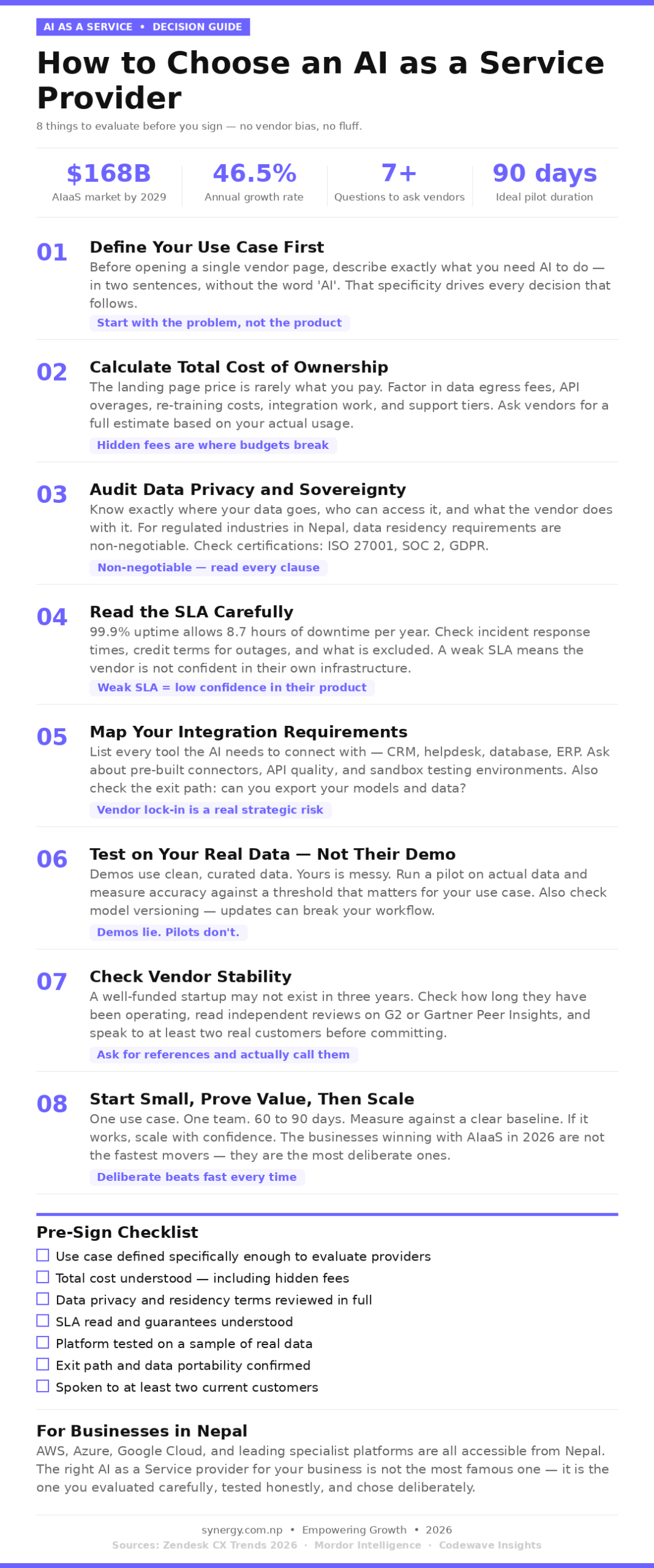
Do not let vendor marketing make this decision for you. Use this checklist, run a real pilot, and choose the AI as a Service provider that fits your actual business — not the one with the best demo. Need help evaluating your options or mapping your first AI use case? The Synergy Digital team works with Nepali businesses on exactly this. Get in touch and let us help you make a decision you will not regret.
FAQ
1. What is the most important factor when choosing an AI as a Service provider? Your use case specificity. If you cannot describe exactly what you need AI to do, you cannot evaluate any provider accurately. Start there before you look at a single vendor page.
2. Are big providers like AWS and Azure always safer choices than specialist platforms? Not necessarily. Specialist providers like CoreWeave and Lambda Labs now serve Fortune 500 companies with strong SLAs. The right choice depends on your workload, budget, and integration needs — not brand recognition alone.
3. How do I know if an AIaaS provider’s pricing is fair? Ask for a total cost estimate based on your actual usage numbers. Factor in egress fees, overages, support tiers, and integration work. If the vendor only shows you a base rate and avoids specifics, that is a red flag.
4. Can businesses in Nepal access leading AI as a Service platforms? Yes. AWS, Microsoft Azure, Google Cloud, and most specialist AIaaS providers are accessible from Nepal with standard internet connectivity and a valid payment method. Data residency rules are worth checking for regulated industries, but access itself is not a barrier.
5. How long should a pilot test run before committing to an AIaaS provider? 60 to 90 days on a single, well-defined use case. That is enough time to see real-world performance, spot integration issues, and measure outcomes against a clear baseline — without over-committing your budget or your team.


