
Table of Contents
Everyone wants to build an AI startup right now. Very few founders stop to ask a boring but critical question first. What hardware will actually run this thing, and who is paying for it?
Here is the uncomfortable truth. Most AI startups do not die because their model is bad. They die because their compute bill grows faster than their revenue. The model works. The demo impresses investors. Then the monthly GPU invoice arrives and the math stops making sense.
So before you build anything, let me walk you through what every founder should know about picking a GPU for AI startups. Not the marketing version. The version that decides whether your company survives year two.
1. Understand What a GPU Actually Does for Your Business
A GPU is not just a fast chip. For an AI company, it is your factory floor.
Every prediction your product makes, every chatbot reply, every document it reads, every voice it processes runs through a GPU somewhere. That means every second of GPU time has a cost, and every customer interaction either covers that cost or eats into your runway.
Think of it like a restaurant kitchen. The stove does not make you money. The meals coming out of it do. A founder who buys a giant industrial kitchen before knowing the menu, the prices, or the number of customers is not being ambitious. They are being careless.
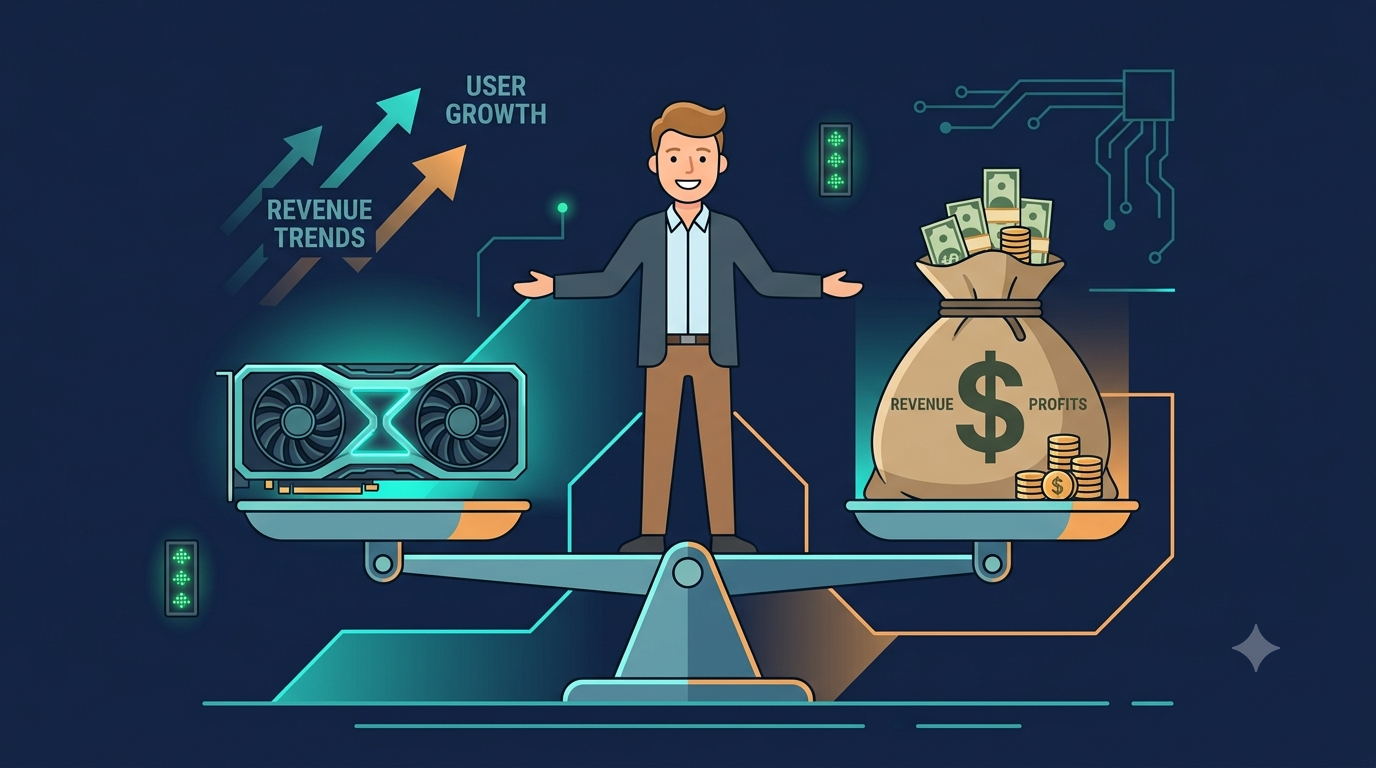
The same logic applies to any GPU for AI startups. The hardware is only as valuable as the revenue flowing through it.
2. Know Which GPU Can Run Which AI Model
This is where many first-time founders get lost, so let me simplify it.
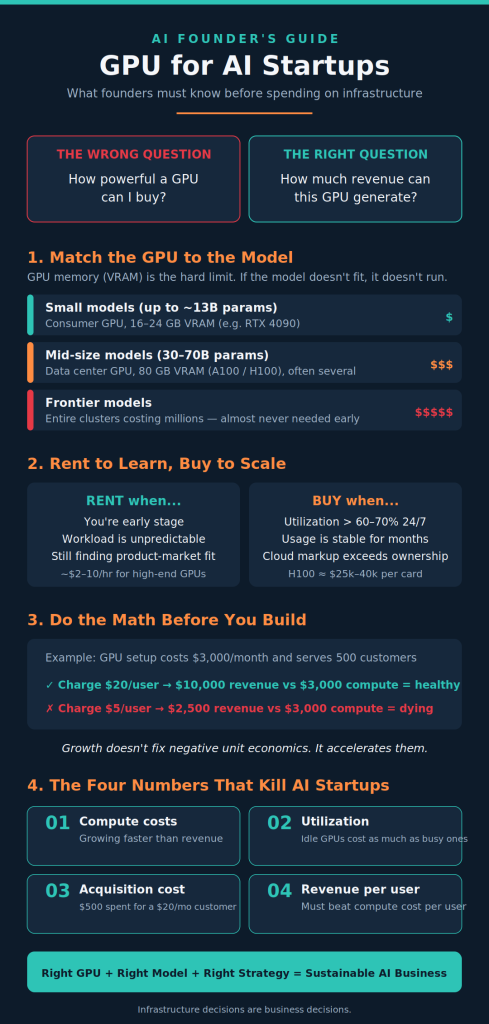
AI models come in sizes, usually measured in parameters. A small 7 billion parameter model can run comfortably on a single consumer-grade GPU with 16 to 24 GB of memory. Something like an RTX 4090 handles it fine. A mid-sized model in the 30 to 70 billion range needs serious data center hardware, like an A100 or H100 with 80 GB of memory, sometimes several of them working together. The largest frontier models need entire clusters that cost millions.
Here is what matters. The memory on the GPU, called VRAM, is usually the hard limit. If the model does not fit in memory, it does not run, no matter how fast the chip is.
So before you price hardware, answer one question honestly. What is the smallest model that solves my customer’s problem well? That answer decides your GPU class, and your GPU class decides your entire cost structure.
3. The Real Cost of a GPU for AI Startups
Let us talk numbers, because vague advice helps nobody.
Buying an H100 outright costs somewhere around 25,000 to 40,000 US dollars per card, depending on supply. A modest server with four of them crosses six figures fast. And that is before electricity, cooling, networking, and the engineer who keeps it all alive.
Renting looks friendlier at first. Cloud providers charge roughly 2 to 10 dollars per hour for high-end GPUs, depending on the provider and commitment level. Smaller GPUs rent for under a dollar an hour.
Sounds cheap? Do the multiplication. One H100 rented at 4 dollars an hour, running around the clock, costs about 35,000 dollars a year. Run four of them and you are burning 140,000 dollars annually on compute alone, before you pay a single salary.
The lesson is simple. The sticker price is never the real price. The real price of a GPU for AI startups is the total cost of keeping it running divided by the revenue it produces.
4. Buying vs Renting a GPU for AI Startups
This is the question I get most often, and the honest answer is that it depends on one thing: utilization.
Rent when you are early. If you are still finding product-market fit, your workload is unpredictable. Some weeks you will hammer the GPUs, other weeks they will sit idle. Renting means you pay only for what you use, and you can switch hardware as your needs change. Flexibility is worth more than ownership at this stage.
Buy when your usage is high and stable. Once your GPUs run above roughly 60 to 70 percent utilization around the clock, month after month, owning becomes cheaper than renting. At that point the cloud markup is money you are handing away.
There is also a middle path. Reserved cloud instances and smaller GPU cloud providers offer big discounts for one to three year commitments. Many startups live in this middle zone for years, and that is perfectly fine.
Bottom line: rent to learn, buy to scale. Never the other way around.
5. Utilization Is the Metric Nobody Talks About
Here is a number that should scare you. A GPU sitting idle costs exactly the same as a GPU doing useful work.
If you own hardware that runs at 20 percent utilization, you are paying five times more per unit of work than the specs suggest. Your expensive H100 effectively becomes the world’s most overpriced space heater.
Smart founders track this obsessively. They batch requests together so the GPU processes many at once. They use quantization, which shrinks models so they need less memory and run faster. They serve smaller models for easy tasks and save the big model for hard ones.
None of this is glamorous. All of it decides your margins. Two startups can use identical hardware and identical models, and one runs at triple the cost of the other purely because of how they manage utilization.
6. You Probably Need Less GPU Than You Think
This might be the most freeing point in this whole article.
If you are building AI customer support agents, document intelligence systems, voice AI solutions, or industry-specific automation, you likely do not need a massive cluster on day one. Most of these products work beautifully on small or mid-sized models, and many can start entirely on API calls to existing model providers with zero GPUs of your own.
Let me explain why that matters. A customer support agent answering questions about your client’s products does not need a frontier model with encyclopedic knowledge. It needs a focused model with access to the right documents. A 7 or 13 billion parameter model, fine-tuned well, often beats a giant general model on this narrow task, at a fraction of the cost.
The pattern repeats across almost every practical AI business. Narrow problem, small model, cheap inference, healthy margins. The founders chasing the biggest models for simple problems are subsidizing their own competition.
7. The Only Question That Matters: How Much Revenue Can This GPU Generate?
Most founders ask how powerful a GPU they can afford. That is the wrong question, and it leads companies straight off a cliff.
The better question flips it around. For every dollar this GPU costs me, how many dollars of revenue does it produce?
Work through a real example. Say your GPU setup costs 3,000 dollars a month and can handle 500 active customers of your support agent product. If you charge 20 dollars per customer per month, that is 10,000 dollars in revenue against 3,000 in compute. Healthy. If you charge 5 dollars, you are earning 2,500 against 3,000 in costs, and you are losing money on every single customer, forever, no matter how fast you grow.
Growth does not fix negative unit economics. It accelerates them. This is why understanding your GPU for AI startups is not an engineering detail. It is the foundation of your pricing, your margins, and your survival.
8. Watch the Four Numbers That Kill AI Startups
The original insight here is worth repeating because it is so consistently true. AI startups rarely fail at building AI. They fail at controlling four numbers.
First, compute costs. If these grow linearly with users but your revenue does not, you have built a machine that converts funding into cloud invoices.
Second, infrastructure utilization. Idle hardware is pure loss, as we covered above.
Third, customer acquisition cost. If it costs you 500 dollars in marketing to win a customer who pays 20 dollars a month, you need that customer to stay for over two years just to break even.
Fourth, revenue per user. This has to comfortably exceed the compute cost per user, with enough room left over to pay for everything else a company needs.
Check these four numbers monthly. The founders who track them make boring, sustainable decisions. The founders who ignore them make exciting announcements right up until the shutdown post.
9. Choosing the Right GPU for AI Startups Is a Business Decision
Here is where everything comes together.
In the AI era, infrastructure choices are not technical footnotes handled by whoever knows Linux best. They shape your pricing, your margins, your fundraising story, and your ability to survive a slow quarter. A founder who cannot explain their cost per inference is a founder who does not actually understand their own business model.
You do not need to become a hardware engineer. You do need to understand the relationship between model size, GPU cost, and revenue well enough to make informed calls. The right GPU plus the right model plus the right business strategy creates a sustainable company. Any one of those alone creates an expensive hobby.
Start small. Rent before you buy. Pick the smallest model that delights your customer. Measure utilization like your life depends on it, because your company’s life does. Then scale the parts that are already profitable.
That is the whole game.
FAQ
1. Do I need to buy a GPU to start an AI startup?
No. Most startups should begin with cloud GPUs or even API access to existing models. Buy hardware only when your usage is high, stable, and predictable enough that ownership becomes clearly cheaper than renting.
2. Which GPU is best for running small AI models?
For models up to around 13 billion parameters, consumer GPUs like the RTX 4090 with 24 GB of memory work well. Larger models need data center cards such as the A100 or H100. The key limit is GPU memory, since the model must fit in it to run.
3. How much does GPU compute cost per month for a small AI product?
A modest setup on rented cloud GPUs typically runs from a few hundred to a few thousand dollars per month, depending on model size and traffic. The important figure is not the total cost but your cost per customer compared to revenue per customer.
4. When should an AI startup switch from renting to buying GPUs?
The common threshold is sustained utilization above roughly 60 to 70 percent around the clock for several months. Below that, the flexibility of renting usually outweighs the savings of ownership.
5. Why do AI startups fail even with good technology?
Because unit economics fail before the technology does. If compute cost per user exceeds revenue per user, growth only deepens the losses. Successful AI startups control compute costs, utilization, acquisition costs, and revenue per user from day one.
Ready to Get Your AI Infrastructure Right?
If you are planning an AI product and want help selecting the right model, choosing GPU infrastructure that fits your budget, or understanding cost versus performance for your specific idea, reach out to us. We help founders make infrastructure decisions that support the business instead of draining it. Send us a message and let us evaluate your setup before you spend, not after.


