

SEO Description: Discover how AIaaS & GPaaS in Nepal will reshape business from 2025–2027. Key trends, risks, and opportunities explained.
Focus Keywords: AIaaS & GPaaS in Nepal, Nepali businesses, cloud services, AI adoption, digital transformation
Tags: AIaaS, GPaaS, Nepal, cloud computing, digital transformation, SMEs, AI adoption, customer checklist, future trends, business strategy
Nepal is entering a decisive phase in technology adoption. AIaaS (Artificial Intelligence as a Service) and GPaaS (General Platform as a Service) are no longer abstract ideas; they are becoming practical tools for businesses, governments, and startups. Here’s what matters: between 2025 and 2027, customers in Nepal will face choices that determine whether these platforms become engines of growth or sources of frustration.
This guide breaks down the future of AIaaS & GPaaS in Nepal into clear, actionable points. Each section highlights what customers should watch for, what pitfalls to avoid, and where the real opportunities lie.
1. Local Relevance Will Decide Adoption
Global platforms are powerful, but Nepali businesses need solutions that speak their language—literally and culturally. Expect demand for Nepali-language interfaces, localized datasets, and compliance with local regulations. Customers should ask providers how well their services adapt to Nepali contexts, not just global benchmarks.
Bottom line: if a platform doesn’t feel usable in Nepal, it won’t scale in Nepal.
2. Pricing Models Will Shape Accessibility
Subscription costs, pay-per-use models, and bundled services will determine who gets access. SMEs in Nepal often operate on tight margins, so transparent pricing matters. Watch for providers offering flexible tiers that match local purchasing power. Hidden costs in data storage or API calls can quickly erode trust.
Here’s the key: affordability isn’t just about low prices, it’s about predictable costs.
3. Security and Trust Are Non-Negotiable
Data privacy is becoming a serious concern. Nepali businesses will demand clarity on where their data is stored, who has access, and how it is protected. Providers that can demonstrate compliance with both global standards and local expectations will win trust. Customers should insist on clear answers about encryption, backups, and disaster recovery.
Trust isn’t built on promises—it’s built on transparency.
4. Integration With Existing Systems
Most Nepali companies already use a mix of tools—ERP, accounting software, HR platforms. The future of AIaaS & GPaaS in Nepal depends on how easily these services integrate with what businesses already have. Watch for providers offering plug-and-play APIs, Docker-ready deployments, and GUI-based dashboards that don’t require advanced coding skills.
If integration feels like a headache, adoption stalls.
5. The Rise of Hybrid and Local Hosting
Not every company wants to rely fully on foreign cloud servers. Between 2025 and 2027, hybrid models—mixing local hosting with global cloud—will gain traction. This reduces latency, improves compliance, and builds confidence. Customers should ask providers about local data centers, edge computing options, and hybrid deployment strategies.
Here’s the takeaway: local presence equals local trust.
6. Talent and Training Will Be the Bottleneck
Technology is only as useful as the people who operate it. Nepal’s workforce needs training in AI workflows, API management, and cloud-native thinking. Providers who invest in education—through workshops, certifications, and Nepali-language documentation—will stand out. Customers should evaluate not just the platform, but the ecosystem of support around it.
No training, no transformation.
7. Benchmarking Global Standards With Local Needs
Nepali businesses will compare platforms against global leaders. But the real question is: do these platforms solve local problems? For example, can they handle Nepali script in OCR systems, or adapt to local payment gateways? Customers should demand benchmarks that reflect both global performance and local usability.
Global excellence means little if local needs are ignored.
8. Government Policy Will Influence Growth
Expect new regulations around data sovereignty, taxation, and digital governance. The government’s Digital Nepal Framework will push adoption, but also set rules. Customers should stay alert to policy changes that affect compliance, especially in finance, healthcare, and education sectors.
Policy isn’t background noise—it’s a growth driver or barrier.
9. Customer Support Will Make or Break Trust
Nepali businesses value responsive, humanized support. Providers offering 24/7 assistance, Nepali-language help desks, and clear escalation paths will gain loyalty. Customers should test support before committing—slow responses during onboarding often signal bigger problems down the line.
Support isn’t a feature, it’s a lifeline.
10. The Opportunity for SMEs and Startups
Between 2025 and 2027, SMEs and startups will be the real drivers of adoption. They are agile, cost-sensitive, and hungry for growth. Platforms that empower them with affordable AI tools, easy GPaaS integration, and localized solutions will reshape Nepal’s digital economy.
Here’s the bottom line: the future of AIaaS & GPaaS in Nepal will be written by small businesses, not just big enterprises.
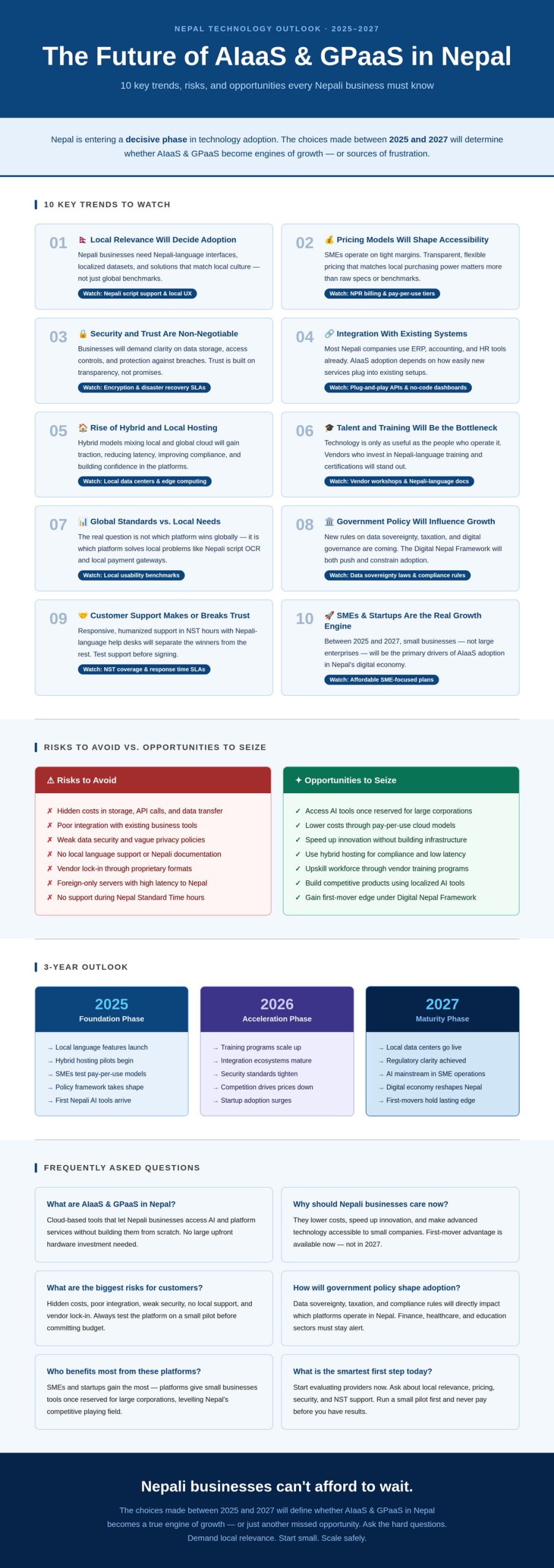
FAQs
Q1: What is AIaaS & GPaaS in Nepal?
AIaaS means Artificial Intelligence as a Service, GPaaS means General Platform as a Service. In Nepal, these are cloud-based tools that allow businesses to access AI and platform services without building them from scratch.
Q2: Why should Nepali businesses care about AIaaS & GPaaS?
Because they lower costs, speed up innovation, and make advanced technology accessible even to small companies.
Q3: What risks should customers watch for?
Hidden costs, poor integration, weak security, and lack of local relevance are the main risks.
Q4: How will government policy affect AIaaS & GPaaS in Nepal?
Policies on data sovereignty, taxation, and compliance will directly impact adoption. Businesses must stay updated.
Q5: Who benefits most from AIaaS & GPaaS in Nepal?
SMEs and startups stand to gain the most, as these platforms give them tools previously reserved for large corporations.
Call to Action
Nepali businesses can’t afford to wait. Start evaluating providers now, ask the hard questions, and demand local relevance. The choices made between 2025 and 2027 will define whether AIaaS & GPaaS in Nepal becomes a true engine of growth—or just another missed opportunity.


